Lights Out Automation: How PLC’s & Software Integration Drive Change
What is Lights Out Automation?
Lights out automation, also known as ‘dark factories’, is the concept of full automation of a production process or factory so that it requires minimal or no human labour presence on the site. Therefore the production process is able to run with the ‘lights out’. It involves using advanced automation technologies, such as artificial intelligence, robotics, machine vision and software integration on a supervisory level and on a machine level using devices such as PLCs. In the years ahead, experts predict that industries such as electronics, automotive, pharmaceutical, and consumer goods will increasingly adopt the lights-out model to cut costs and boost efficiency. In particular, the pharmaceutical manufacturing industry stands to gain significantly from the adoption of lights out automation.
Benefits in Pharmaceutical Manufacturing:
For the pharmaceutical industry, lights out automation represents a significant opportunity to improve quality and consistency, as well as reduce costs. In traditional pharmaceutical manufacturing these can be some of the biggest challenges. By switching to a lights out manufacturing line, human error is essentially eliminated, leading to more reliable and higher quality production. This also allows for much better contamination control, where a sterile environment is much easier to achieve and maintain when human workers are not rotating in and out of the area. The environment, such as temperature, humidity and atmosphere, can be optimised for the manufacturing process as well when there is no need to regularly accommodate people.
The Role of PLC’s
In a lights out manufacturing environment Programmable Logic Controllers (PLCs) play a central role in ensuring reliable, continuous, and compliant production. In pharmaceutical processes, PLCs can automate and control complex processes such as mixing, granulation, tablet pressing, coating, and packaging. As examples, PLCs such as the Siemens S7-1200 can be used for equipment sequencing and interlocking, flow rate, temperature and pressure control, dosing and timing. More advanced processors such as the Siemens S7-1500 (pictured below) range can be used for more complex machinery, regulatory compliance and data integrity, capturing real-time data, and, for critical applications, can be configured with redundant CPUs with the S7-1500 R/H. PLCs can continuously monitor systems for faults, provide diagnostics, shutdown processes in unsafe conditions and provide maintenance alerts to reduce downtime.
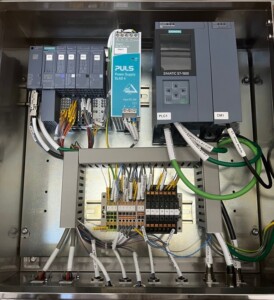
One of the key areas where PLCs support lights out automation is that they can interface to higher-level, supervisory systems such as SCADA and MES. SCADA provide visualisation of the processes, alarm views and high-level controls, and MES can be used for batch management records and equipment management. For lights out manufacturing these systems can be accessed away from the production line, even off-site, so the process can still be fully monitored and validated.
Software integration is essential in cleanroom environments because it enables automated, compliant, and contamination-free operations. It brings together multiple systems to function as a cohesive network, therefore maximising efficiency, traceability, and product quality while minimising risks and the need for manual intervention.
Compliance in Lights Out Automation
As the pharmaceutical and life sciences industries move toward lights out automation, the compliance responsibilities shift from operators to the systems and software. These systems must operate consistently within validated parameters, generate secure and traceable electronic records, detect process deviations, and maintain complete audit trails for inspection. Validation provides the documented evidence that an automated system does what it is intended to do, reliably and reproducibly. GAMP 5 serves as globally accepted guidelines for validating automated systems in regulated environments. It supports a risk-based approach, encouraging manufacturers and developers to focus validation efforts on areas that pose the greatest risk to patient safety, product quality, or data integrity.
By categorising systems based on complexity and risk, GAMP 5 helps avoid under-validation. In lights out environments, this guidance is especially valuable, as it aligns validation with the real-world operational and compliance needs of the systems, and provides the reassurance needed that absence of operators does not mean an absence of oversight. Lights out automation represents a major shift in both technology and mindset. It affects not only production systems, but also quality management systems, worker roles, validation procedures, and IT infrastructure. As seen in the image below, Feed4ward has based their quality management system around the principles of GAMP5

A gradual approach allows organisations to manage and control these changes. Repeatable but high-value processes such as filling, labelling, or routine QC checks are easier to automate because their logic, steps, and requirements are well-defined, therefore simplifying the automation and making the validation more straightforward. These processes typically have fewer variables or edge cases, which reduces the need for human intervention.
A Summary of Lights Out Automation
Lights out automation represents an incredible opportunity for pharmaceutical manufacturing, offering the potential to improve product quality, reduce operational costs, minimise human error, and increase overall efficiency. However, achieving this vision requires a thoughtful approach to validation, software integration, quality management, and organisational changes. By embracing a phased, strategic implementation which is grounded in GAMP principles and supported by a robust QMS, pharmaceutical manufacturers and integrators can confidently move forward in the evolving industry.

